Field notes for the age of AI answers.
Research, news and practical guides on how AI systems find, describe and recommend brands.

OpenAI plans visual ads beside ChatGPT image generation
OpenAI says it will test labeled visual ads beside ChatGPT image generation in the U.S. later this month. The format is separate from answers, while its commercial effect remains unmeasured.Latest articles

How long do AI citations last? Evidence from 535 tracked citations
83% of first-time ChatGPT and Gemini citations were not repeated within 14 days. What the data shows, and why checking cadence changes the answer.ChatGPT adds virtual try-ons to product discovery
OpenAI has added virtual try-ons and saved Favorites to ChatGPT shopping results. The update adds a visual and persistent step to discovery, while selection and merchant effects remain undocumented.Reports put Google’s AI contribution pilot at about 100 publishers
New reporting adds scale and payment estimates to Google’s publisher-contribution experiment. The figures are reported pilot data, not public Google rate-card terms.Google rolls AI Mode information monitoring out globally
Google says AI Mode can now revisit changing web, local, and shopping information for all users. The rollout does not disclose source selection or referral effects.Google reportedly tests Flipkart checkout in Gemini and AI Mode
A reported limited India test puts a Flipkart-branded Buy flow alongside product listings. Google’s UCP materials describe direct buying on these surfaces, but do not confirm this pilot.ChatGPT accounted for 95.1% of tracked AI referrals in August
BrightEdge reports a highly concentrated referral channel, while disclosing a historical-data adjustment. It is a vendor dataset—not a complete measure of AI visibility.
Google says AI Max will show the query-to-landing-page path
A newly announced report would connect search terms, the creative shown, and the landing page in one view. It is a paid-search measurement change, not an organic AI visibility report.UK proposal would open Google’s choice screen to AI assistants
The CMA proposes letting qualifying AI assistants join Android and Chrome search-choice screens—and requiring clear publisher attribution. It is a consultation, not a rollout.Google’s result-delivery changes put visibility data under review
Two monitoring vendors report retrieval disruption as Google changes delivery mechanics. That is a measurement problem—not evidence of a ranking collapse.
Google puts an AI-shopping visibility record inside Merchant Center
Google’s newly highlighted Merchant Center report separates organic AI shopping exposure from paid traffic—and makes product-data gaps easier to inspect.Sponsored Agents turn a ChatGPT ad into a separate brand conversation
OpenAI is testing a clearly labelled business agent after a ChatGPT ad click. It changes the paid discovery flow—not the platform’s independent answers.Perplexity’s new retrieval benchmark makes one AI-search layer easier to inspect
Q2D-Web evaluates which documents enter an agentic search system’s candidate set. It is not a citation report—but it sharpens the distinction.ChatGPT Ads is expanding self-service access—and changing the discovery record
OpenAI says advertisers can now buy directly across India, Europe, the Middle East, and North Africa. That makes paid placement a distinct signal to separate from the answer itself.A brief Google AI Mode citation failure is already a measurement lesson
Links reportedly disappeared in a new Gemini 3.8 Flash variant, then returned. The episode shows why teams need answer-level records.The EU now treats ChatGPT as a very large search engine
The DSA designation recognizes ChatGPT’s place in discovery and adds new risk and transparency duties—but it changes no brand ranking overnight.Google’s Search Console AI reports are now available worldwide
Dedicated impression reports for AI Overviews and AI Mode give teams a new baseline—but not a complete measure of AI-search value.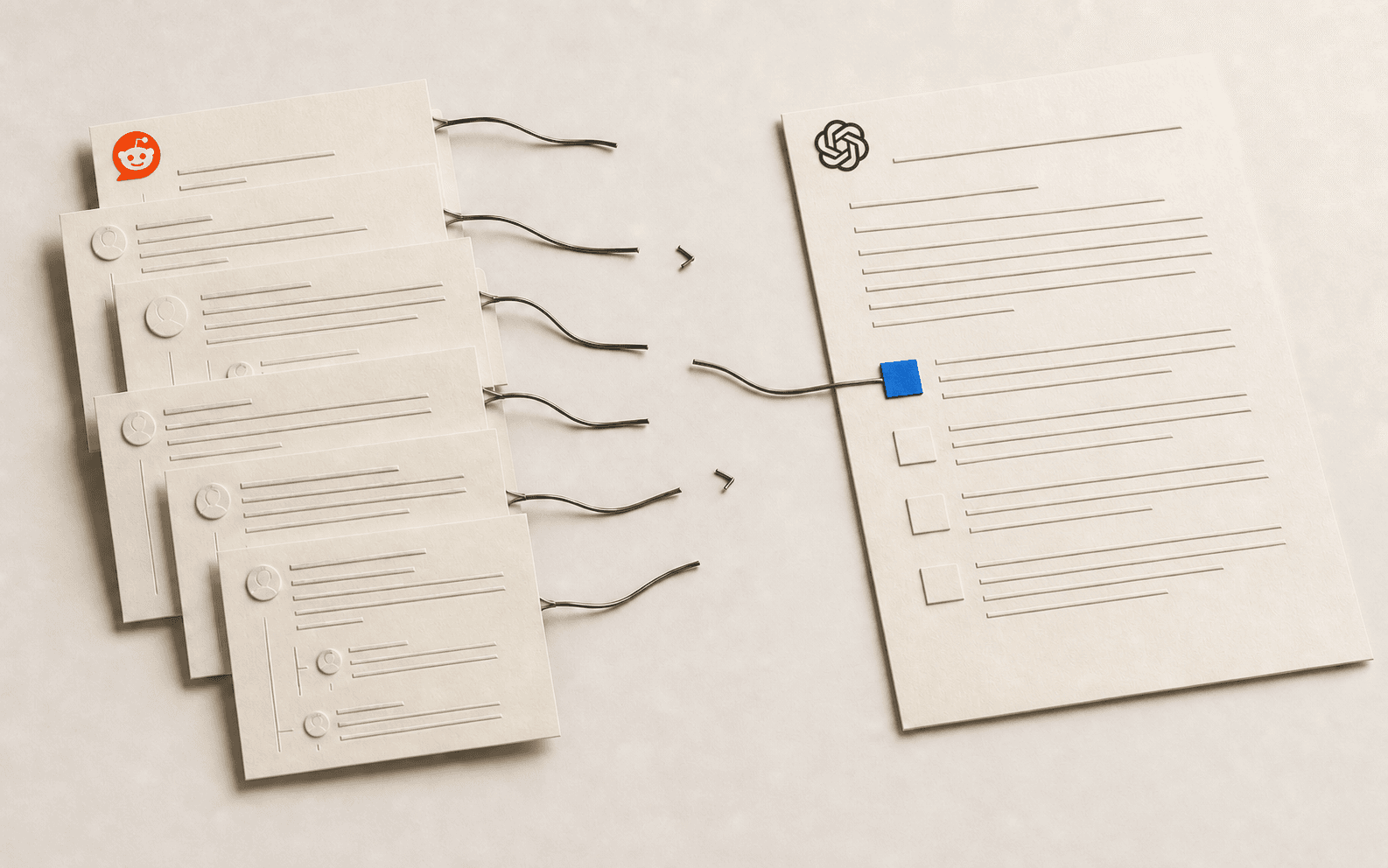
Reddit citations in ChatGPT Search reportedly fell 86% in August
Promptwatch data points to a sharp mid-August change—but the cause and permanence remain unconfirmed.
AI visibility is not one score. It is a system of evidence.
A practical model for connecting mentions, recommendations, citations, sentiment, and competitor movement.How brands enter AI answers: a measurement framework
A method for segmenting buyer questions, answer roles, citations, and uncertainty without treating prompt counts as rankings.
From citation gap to content brief: a measurable GEO workflow
How to turn a missing source into owned evidence, independent authority, and a repeatable impact check.
Why realistic user context changes AI-search measurement
Isolated API prompts miss the path users take. Here is how controlled context improves the signal.
The new competitive field is the answer, not the result page
A framework for understanding which brands AI recommends and what evidence shapes the category.
How teams make AI visibility part of weekly marketing work
A compact operating rhythm for signals, actions, owners, and validation across brand and technical teams.
What is AI search visibility and why it is the new SEO
A practical introduction to how answer engines reshape brand discovery and the signals that matter.
How to monitor your brand in AI answers
A repeatable framework for tracking mentions, recommendations, citations, and factual accuracy across AI answer experiences.
Why AI recommends some brands—and ignores others
The evidence, authority, and trust signals that shape which brands appear in answers.
How ChatGPT, Gemini, and Perplexity recommend brands
The practical differences between major answer engines and what they mean for visibility work.
LLM hallucinations about your brand
A clear process for finding and correcting misleading AI claims before they affect buyers.
From monitoring to action
Why signals need a named owner, a practical next step, and a follow-up measurement.
Compare AI model answers without losing the evidence
A practical model for reviewing brand mentions across the AI systems you track, with prompt and source context intact.Your AI visibility problem is quietly killing ad performance
Why paid media and answer-engine visibility need to be measured together.Psychology and AI brand recommendations: what can be tested
A testable way to review authority, independent evidence, and brand consistency without assuming hidden ranking weights.
Scarcity vs. social proof in paid search: a testing framework
How to compare truthful urgency and verifiable proof in ad-copy tests without claiming unpublished results.
Google Ads character limits and AI generation
Why language models struggle with ad-length compliance and how teams can keep output reliable.
How to size the AI search intelligence market
Define the category, validate buyer budgets, and test adoption assumptions before publishing a market estimate.The AI visibility forecast: 5 signals worth tracking in the next quarter
A practical way to separate meaningful movement in answer engines from the noise of one-off prompts and volatile rankings.Build a prompt portfolio that mirrors how buyers actually research
Move beyond a handful of vanity questions with a portfolio that captures category, comparison, and decision-stage intent.Which sources shape AI answers—and how to prioritize the ones that matter
A smarter way to map owned, earned, and third-party sources without reducing citation strategy to a checklist.The AI shopping shortlist: how product discovery shifts before the click
Why the products named early in an answer matter, and the signals retail teams should inspect before seasonal demand arrives.Google AI surfaces are not one system. Plan measurement accordingly.
A measurement model for separating AI Overviews, AI Mode, and Gemini instead of reporting one misleading Google number.How much answer variance is normal? A guide to reading daily movement
Volatility does not make AI visibility unmeasurable. It changes how teams need to define a meaningful change.Brand entity hygiene: make the facts about your company easy to verify
A practical inventory of the identity, product, and relationship facts that make a brand easier to describe accurately.When to refresh a page for AI search—and when to leave it alone
Use evidence from citations, answer framing, and product change to decide whether a page needs a rewrite, a patch, or nothing.Offsite mentions are part of your AI search surface. Treat them that way.
How to understand the community, editorial, review, and reference sources around your brand without chasing every mention.A reporting model for AI search that leaders can actually use
A concise weekly view of visibility, accuracy, citations, and work-in-progress that avoids manufactured precision.From visibility to revenue: build the measurement chain before you need it
The right way to connect early AI search signals with outcomes, without claiming direct attribution where none exists.